Science & Technology | An exploration of the invisible rules behind everyday life
Imagine balancing a surprisingly heavy object on the tip of one finger. It looks ready to tumble. Now imagine attaching a pair of weighted straps so that they hang down on either side. Counterintuitively, adding weight can make the arrangement easier to balance. You have not switched gravity off. You have persuaded gravity to help you.
That small trick reveals a much bigger idea: some of the most useful technologies begin when someone notices a physical effect that seems to contradict common sense, asks why, and discovers a way to use it.
The balancing act hiding in your kitchen
Try this with two metal forks, a cork, a toothpick and a stable cup. Push the forks into opposite sides of the cork, angled so their handles extend downward. Insert the toothpick into the cork and carefully balance its free tip on the rim of the cup. Adjust the forks until the assembly hangs securely. Keep the experiment low over a table, and avoid sharp or breakable supports.
Without the forks, the cork and toothpick are difficult to balance on such a tiny point. With the forks, the whole assembly can become surprisingly stable. Why? The hanging forks move the center of mass of the combined system downward. If it lies below the support point, a small tilt raises that center of mass. Gravity then produces a restoring torque, encouraging the object to swing back toward its resting position.
Your belt-and-counterweight idea uses the same principle, provided the weights are positioned so that the combined center of mass falls beneath the finger or pivot. Simply attaching weights does not guarantee balance; their locations matter as much as their masses.
Here is the delightful part: the center of mass does not have to be inside any solid part of the object. For a curved or fork-shaped assembly, it can lie in empty space. That is why the object may look as though most of its material is hanging off to one side while the overall system remains balanced.
The invisible arithmetic: torque
A seesaw provides the simplest introduction. A lighter person sitting far from the pivot can balance a heavier person sitting closer to it. The important quantity is torque: the turning effect of a force around a pivot. For a force applied perpendicular to a lever, torque equals force multiplied by its distance from the pivot.
Suppose one side carries a 10-newton weight 20 centimeters from the pivot. Its torque is 2 newton-meters. A 20-newton weight just 10 centimeters from the other side of the pivot produces the same magnitude of torque in the opposite direction. The seesaw can remain level even though the weights differ.
In static equilibrium, the upward and downward forces balance, and the clockwise and counterclockwise torques cancel. This is not a trick or a loophole in physics. It is physics operating precisely as it should.
A ten-second experiment with your own body
Sit upright in a chair with your feet flat on the floor. Try standing without moving your feet or leaning your torso forward. For many people, the attempt feels awkward or impossible. Now lean forward and stand normally. You have moved your body’s center of mass toward the area supported by your feet, allowing you to rise without tipping backward.
This same balancing logic matters when engineers design walking robots, mobility aids and machines that must lift uneven loads. The challenge is not just how much something weighs. It is where the weight acts, how it moves, and how the supporting forces respond.
From dinner-table tricks to aircraft and spacecraft
Aircraft designers pay close attention to center of gravity. A plane loaded too far forward or too far aft can become difficult or unsafe to control. The location of passengers, cargo and fuel therefore matters—not merely their total weight. Engineers use calculations and loading limits to keep an aircraft within its approved balance range.
Spacecraft also have to account for mass distribution, although their orientation in orbit cannot be explained by a hanging weight beneath a pivot. Spacecraft attitude control instead relies on mechanisms such as thrusters and reaction wheels, governed by conservation of angular momentum. The connection is deeper than a visual resemblance: in both cases, engineers must understand forces, torques and the distribution of mass.
Earth from space: a photograph that changed the questions
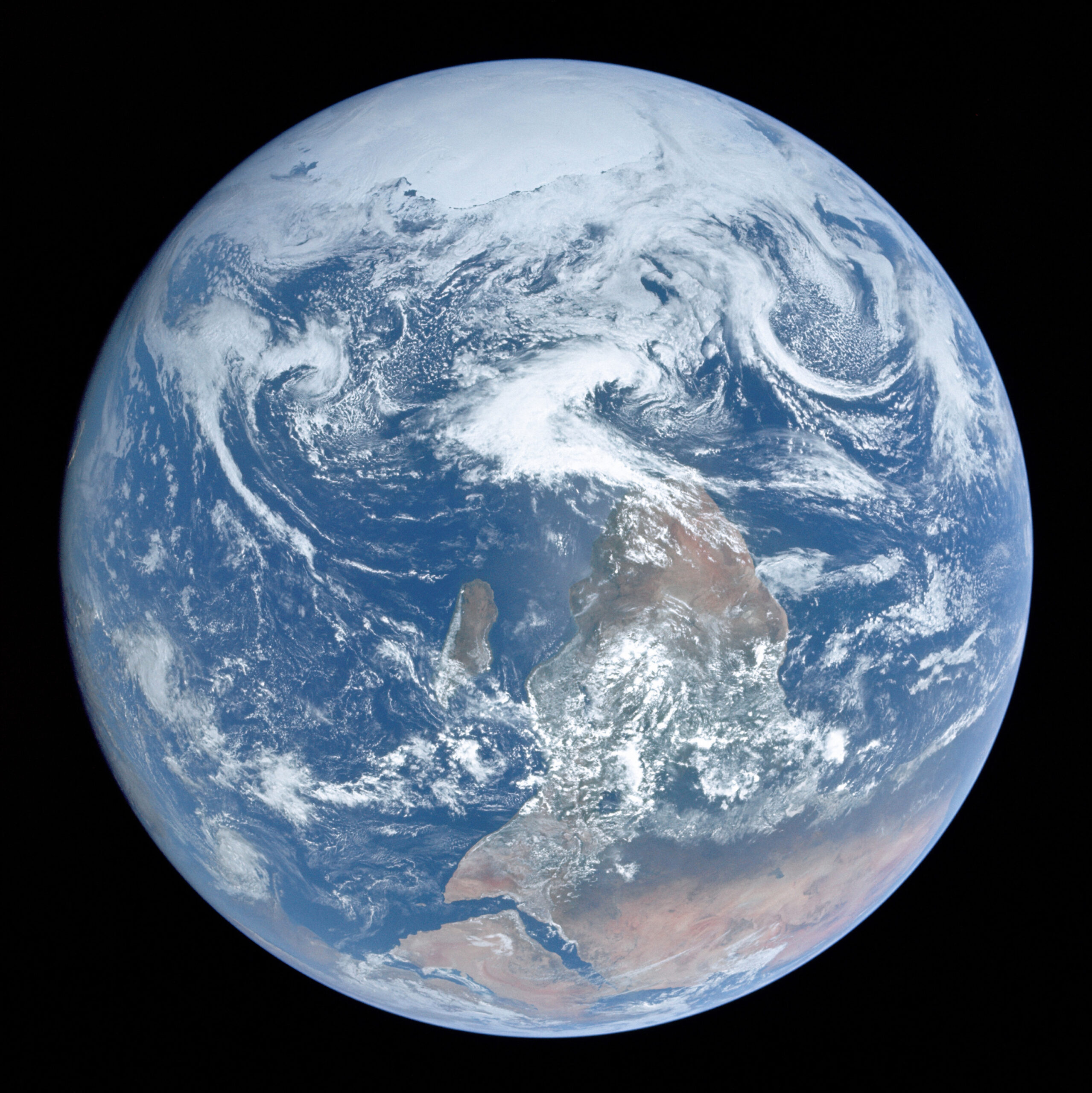
On December 7, 1972, Apollo 17 astronauts photographed the sunlit Earth during their journey toward the Moon. The celebrated image, commonly called the “Blue Marble,” presents our planet as a brilliant sphere against dark space. The featured image accompanying this article is that historical NASA photograph—not a picture taken today.
For all its beauty, a single photograph cannot show everything scientists want to know. Clouds obscure portions of the surface. One camera angle reveals only part of a sphere. A snapshot records one moment rather than a long-term trend. Each limitation invites an engineering question: What if we observe from different places? What if we measure different wavelengths of light? What if we return again and again?
That is where Earth-observing satellites come in. NASA’s 2002 “Blue Marble” visualization, for example, used satellite observations to assemble a detailed global view. It is not one astronaut’s instantaneous photograph. It is a composite constructed from measurements, with the assembly process helping create a broader picture of Earth’s surface.
Another invisible phenomenon: how a satellite sees what our eyes cannot
Visible light is only a narrow slice of the electromagnetic spectrum. Sensors that detect infrared radiation or other wavelengths can reveal information that an ordinary camera does not capture in the same way. Scientists can use differences in reflected or emitted radiation to investigate vegetation, surface temperature, clouds and water.
Think of it as giving technology a new sense. A thermometer does not see temperature as a color, but its measurement can be displayed in colors that humans understand. Similarly, satellite data may be converted into a false-color image to make otherwise invisible patterns easier to interpret. Those colors are analytical choices, not necessarily the colors an astronaut would see through a window.
The principle is remarkably general: find a physical property, build a sensor that responds to it, and turn the measurement into useful information. Medical imaging, industrial inspection and environmental monitoring all depend on variations of that idea.
Three questions that can turn curiosity into invention
When you notice something strange—a fork balanced on a toothpick, a spinning top resisting a change in orientation, or a satellite measuring invisible radiation—ask three questions. What force or interaction is actually responsible? Which variable can I change? Where might controlling that variable solve a real problem?
For the balancing forks, the variables include the mass of the forks, their angle, and the location of the support. For a spinning object, rotation and angular momentum matter. For a satellite sensor, wavelength, sensitivity and observation geometry matter. Each experiment becomes a way of testing an explanation rather than merely admiring an effect.
Scientific curiosity becomes especially powerful when the first explanation is challenged. If adding weight helps one object balance, does adding weight always improve stability? No. Place the extra mass high above the pivot, and the arrangement may become more unstable. That failed prediction is not a disappointment; it reveals the importance of where the mass is added.
The world is full of these invitations to think differently. A finger, a belt, two forks and a toothpick can open a conversation about equilibrium. A photograph of Earth can open a conversation about optics, sensing and planetary science. The extraordinary often begins with an ordinary object and a very good question: Why does that happen?
Featured photograph: Earth seen from Apollo 17, December 7, 1972. NASA, public domain. Historical image.