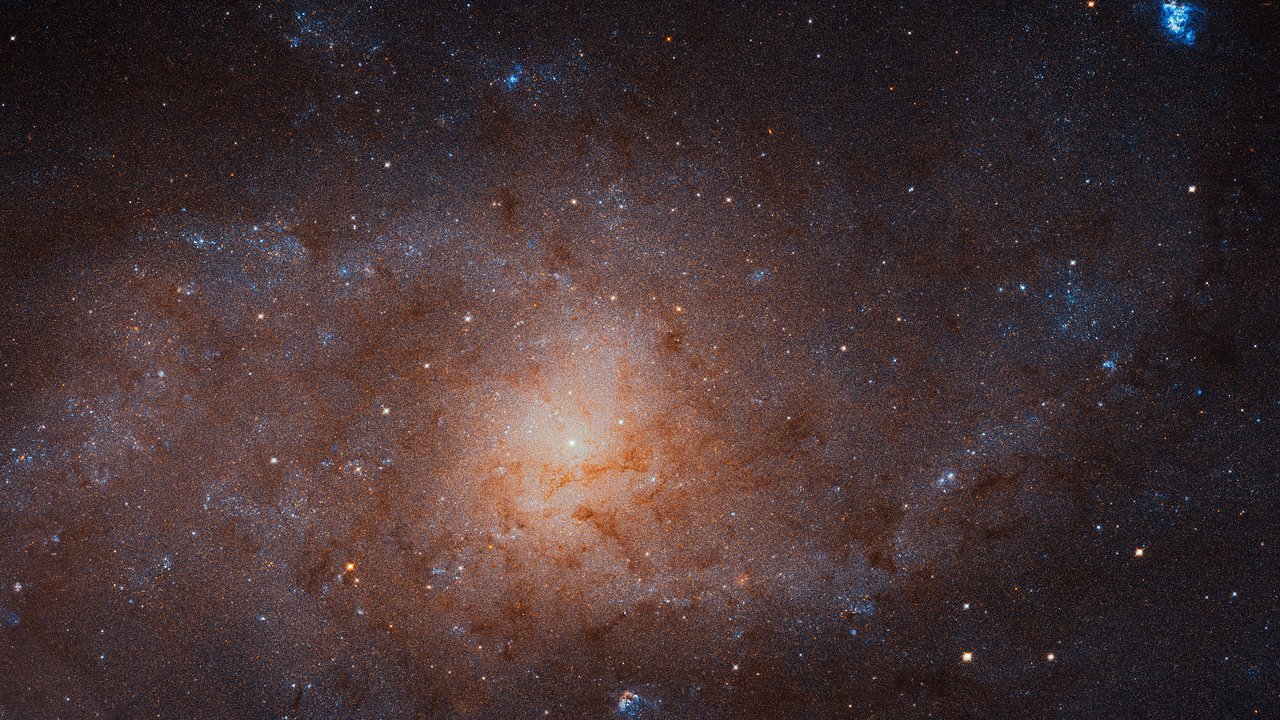
The Hubble Space Telescope has turned its attention to our galactic backyard. A mosaic released Monday shows the center and inner spiral arms of the Triangulum Galaxy in enough detail to pick out millions of individual stars. The image is the second-largest Hubble has released, behind its 2015 portrait of Andromeda.
Triangulum, also known as Messier 33, lies about three million light-years away. The new view draws on roughly 54 pointings of Hubble’s Advanced Camera for Surveys. Combining those exposures made a picture more than 34,000 pixels across. A small reproduction can show the galaxy’s broad shape, but the full mosaic lets readers see how much structure disappears when the image is shrunk to fit a screen.
The bright patches among the stars include nebulae, where clouds of gas can shine under the influence of nearby stars. The mosaic also shows hundreds of star clusters. Seeing these features together gives astronomers a way to study where stars have formed across the galaxy and compare those patterns with what they see in other nearby spirals.
Triangulum’s orientation gives us a relatively open view of its disk. A photograph of a galaxy seen edge-on can compress its structure into a narrow band, with dust and stars overlapping along the line of sight. In this view the inner arms are easier to follow. Move from the dense center toward the arms and the balance between bright knots and darker gaps changes across the frame.
The picture is also a record of patient work. One exposure could capture only part of this field at Hubble’s resolution. The team had to point the telescope repeatedly and build the wider view from those separate observations. The result invites a slower look: pick an arm, follow its curve, and see how many small points of light a single bright patch can contain.
Featured photograph and source: NASA, ESA, and M. Durbin, J. Dalcanton, and B. F. Williams (University of Washington). CC BY 4.0.