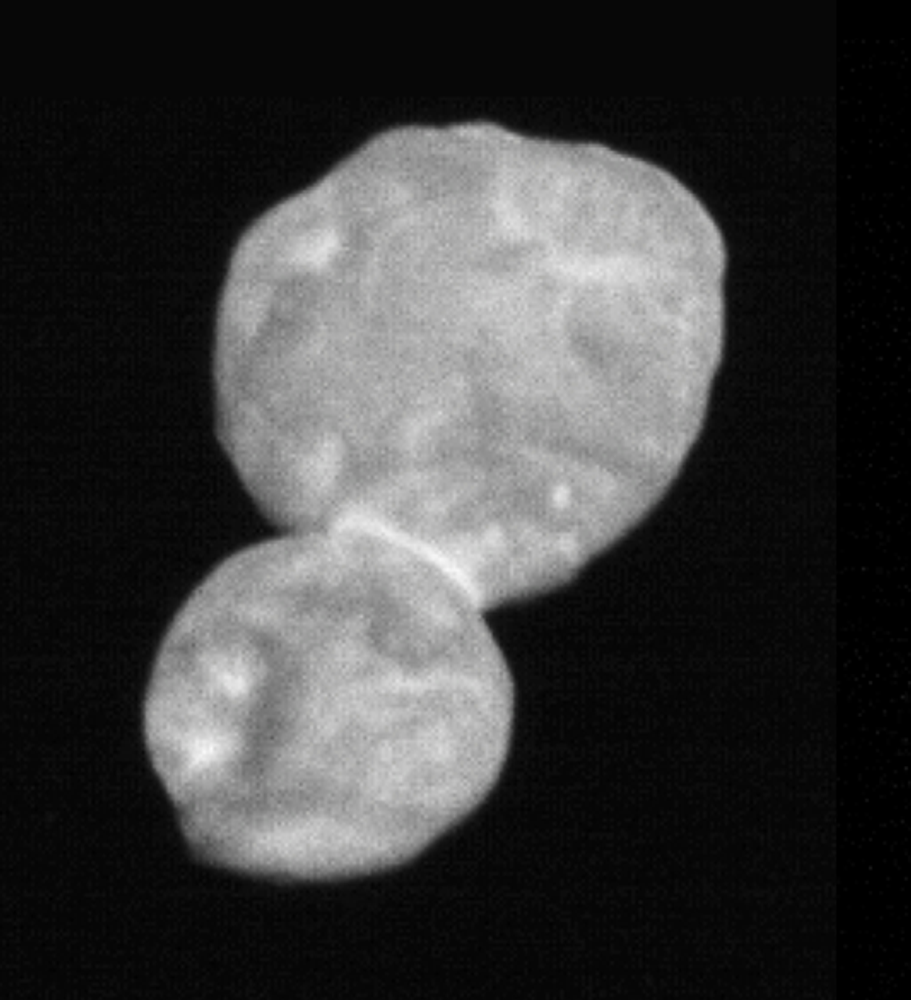
NASA released the first detailed pictures of a small world beyond Neptune on Wednesday, a day after its New Horizons spacecraft swept past it. The object, cataloged as 2014 MU69 and nicknamed Ultima Thule by the mission team, looks like two separate bodies joined at a narrow neck.
The spacecraft photographed the object from about 18,000 miles away roughly half an hour before closest approach. In that black-and-white frame, the larger lobe dominates the view and the smaller one sits off to one side. A separate, lower-resolution color image shows a reddish surface.
New Horizons flew past Pluto in 2015. Its latest target lies in the Kuiper Belt, a region of icy bodies beyond Neptune. The mission team hopes that studying a small object that has survived since the early solar system will help explain how the building blocks of planets came together.
The shape gives scientists a place to start. A violent collision can break small bodies apart. Two distinct lobes joined at a neck are consistent with a much gentler meeting. The early images reveal the outline, while finer details will have to wait for more data.
Wednesday’s release is an early look at what the spacecraft captured during the flyby. The mission team expects more images and measurements to arrive over the coming weeks and months. For now, the pictures show that a tiny point of light in the outer solar system is a world with a shape of its own.
NASA’s January 2 mission update. Featured image credit: NASA/Johns Hopkins University Applied Physics Laboratory/Southwest Research Institute.